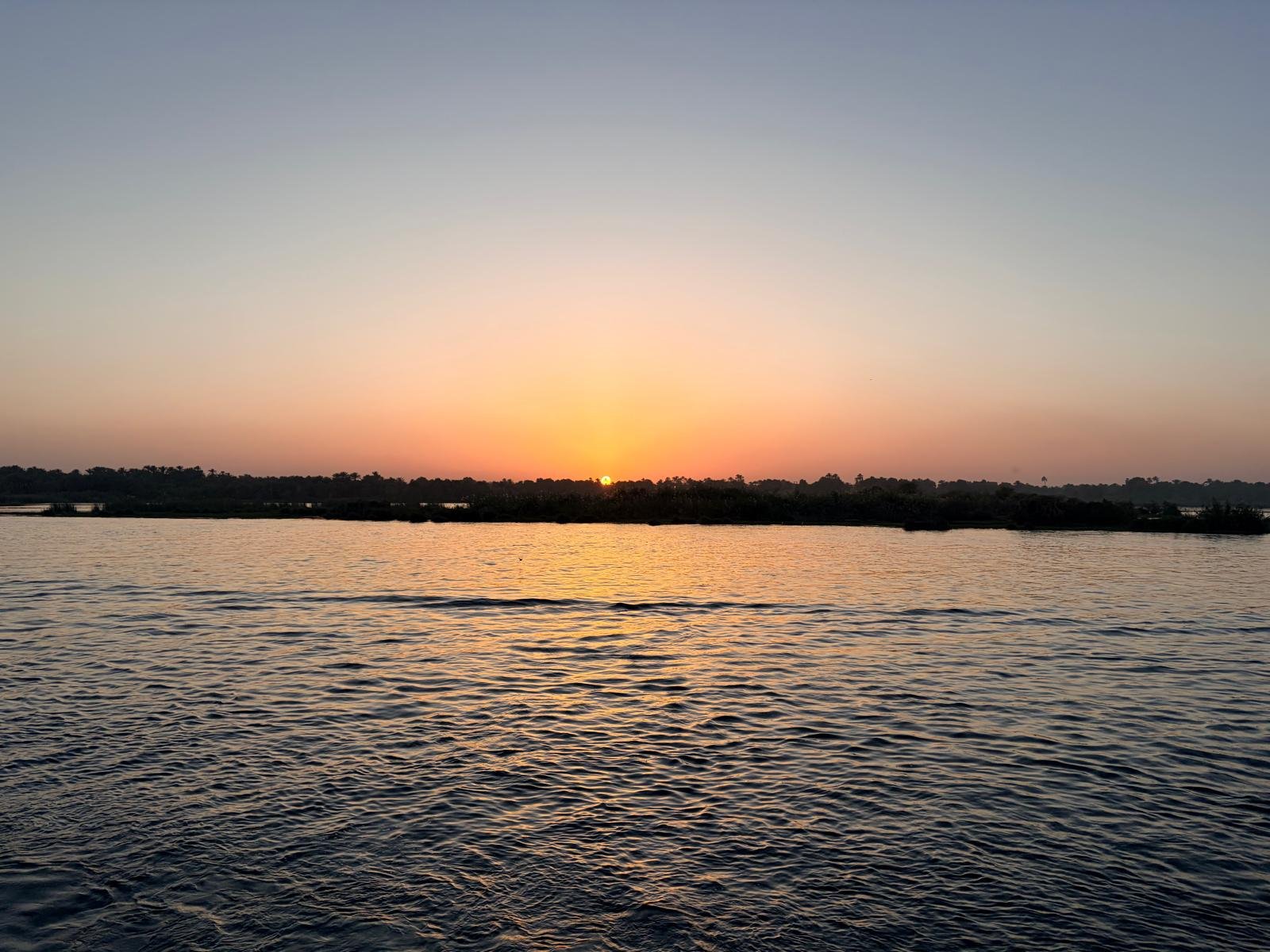
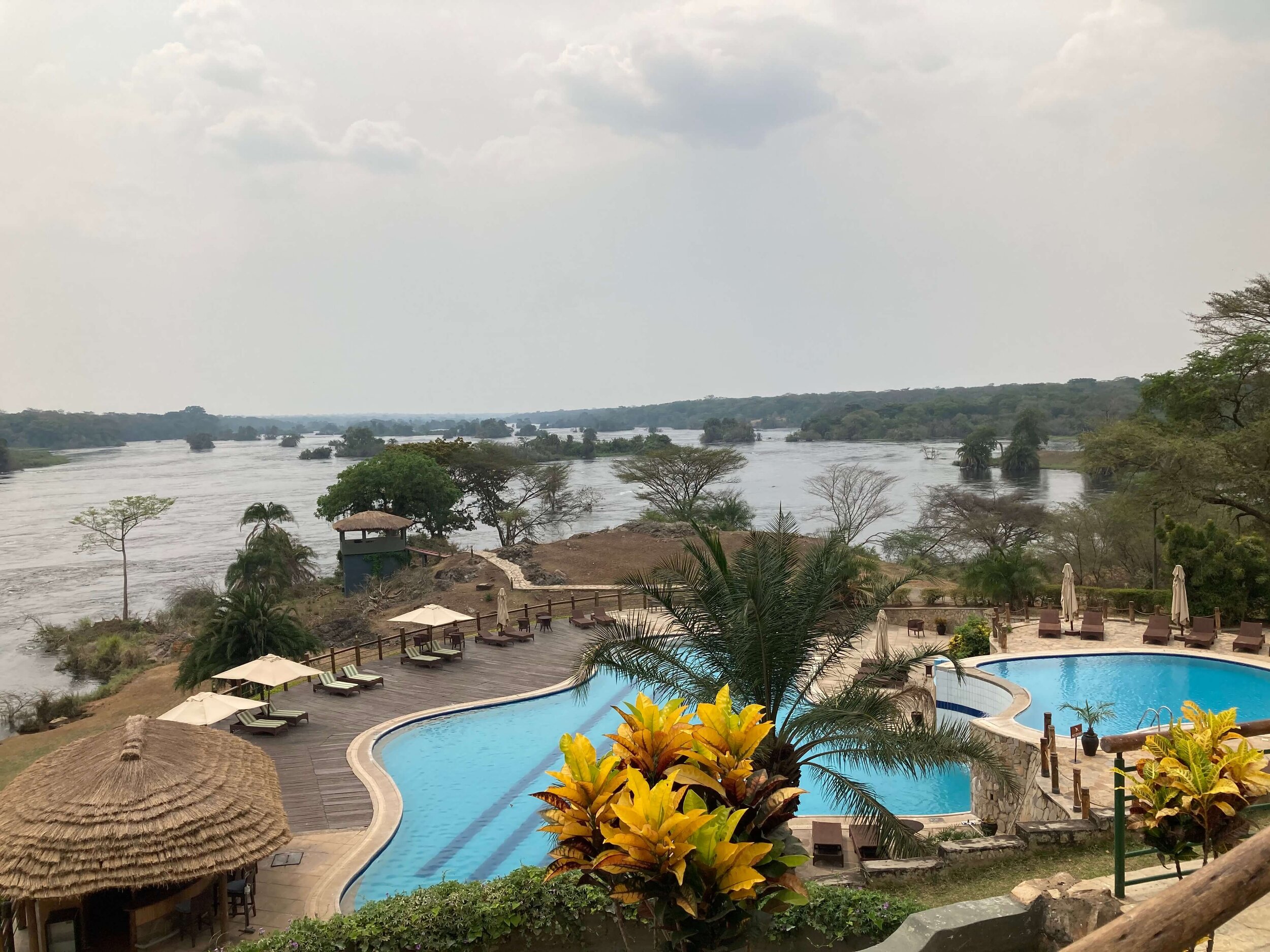
The Nile River. Photo: Muna Moto
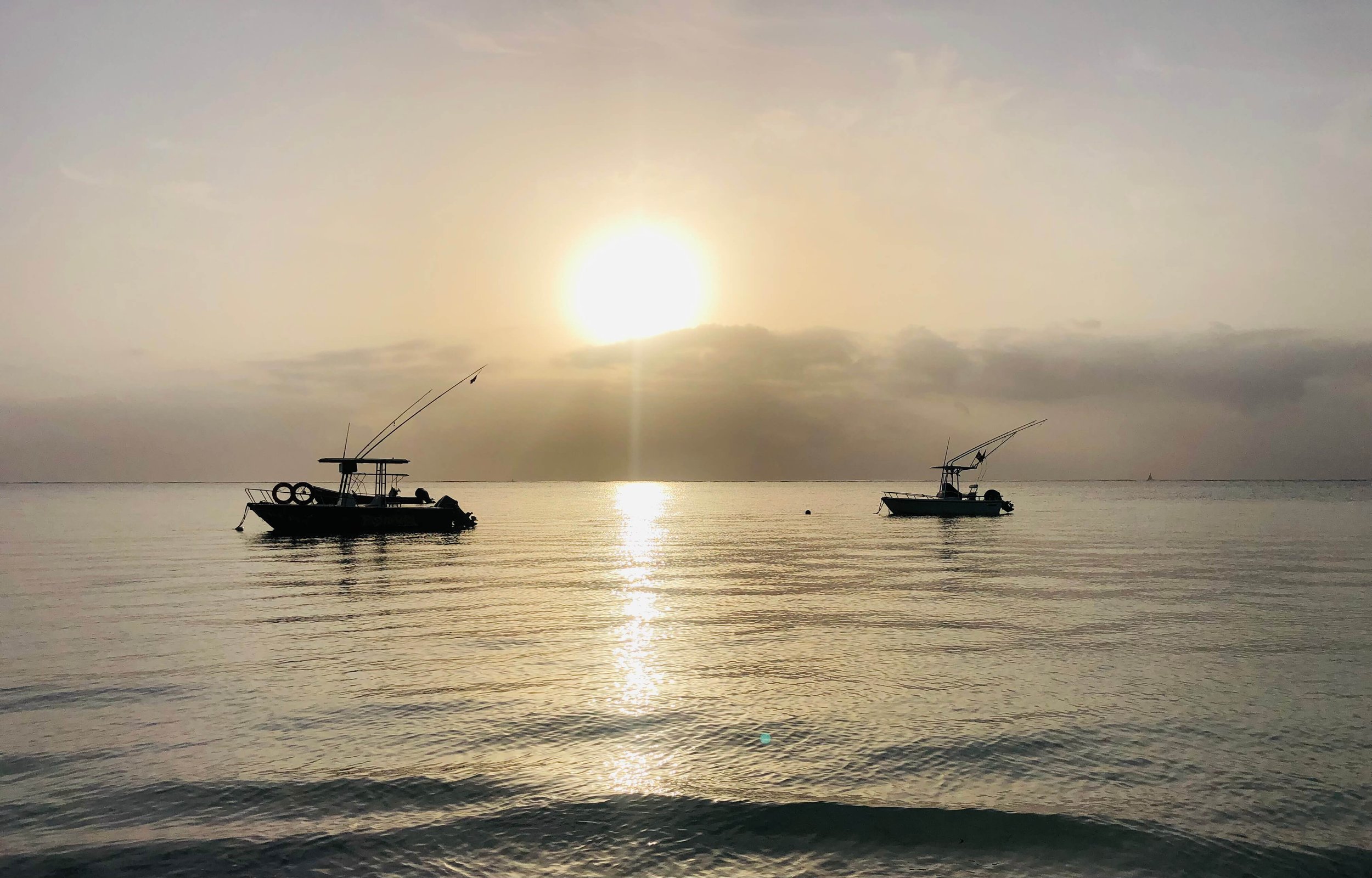
The Nile at sunset has a way of slowing time. From the deck of our boat, somewhere between Luxor and Aswan, the river glows in molten gold, its surface broken only by the quiet passage of feluccas drifting like silhouettes across history.
For five days, we have moved along this ancient artery, retracing a journey that predates memory itself. Each bend in the river reveals another layer of a civilization that has endured for millennia.
And yet, as we approach Aswan today, the sky has shifted, winds rising, the horizon blurring into a thick veil of sand. A desert storm gathers, reminding us that Egypt is not only history carved in stone, but also a living, breathing landscape in constant motion.
To travel along the Nile River is to move through time. Long before Greece articulated philosophy or Rome codified empire, Egypt had already built a civilization of staggering sophistication. Here, along these fertile banks, arose one of humanity’s first great experiments in organized society, complete with architecture, administration, religion, and art that still shape our imagination today.
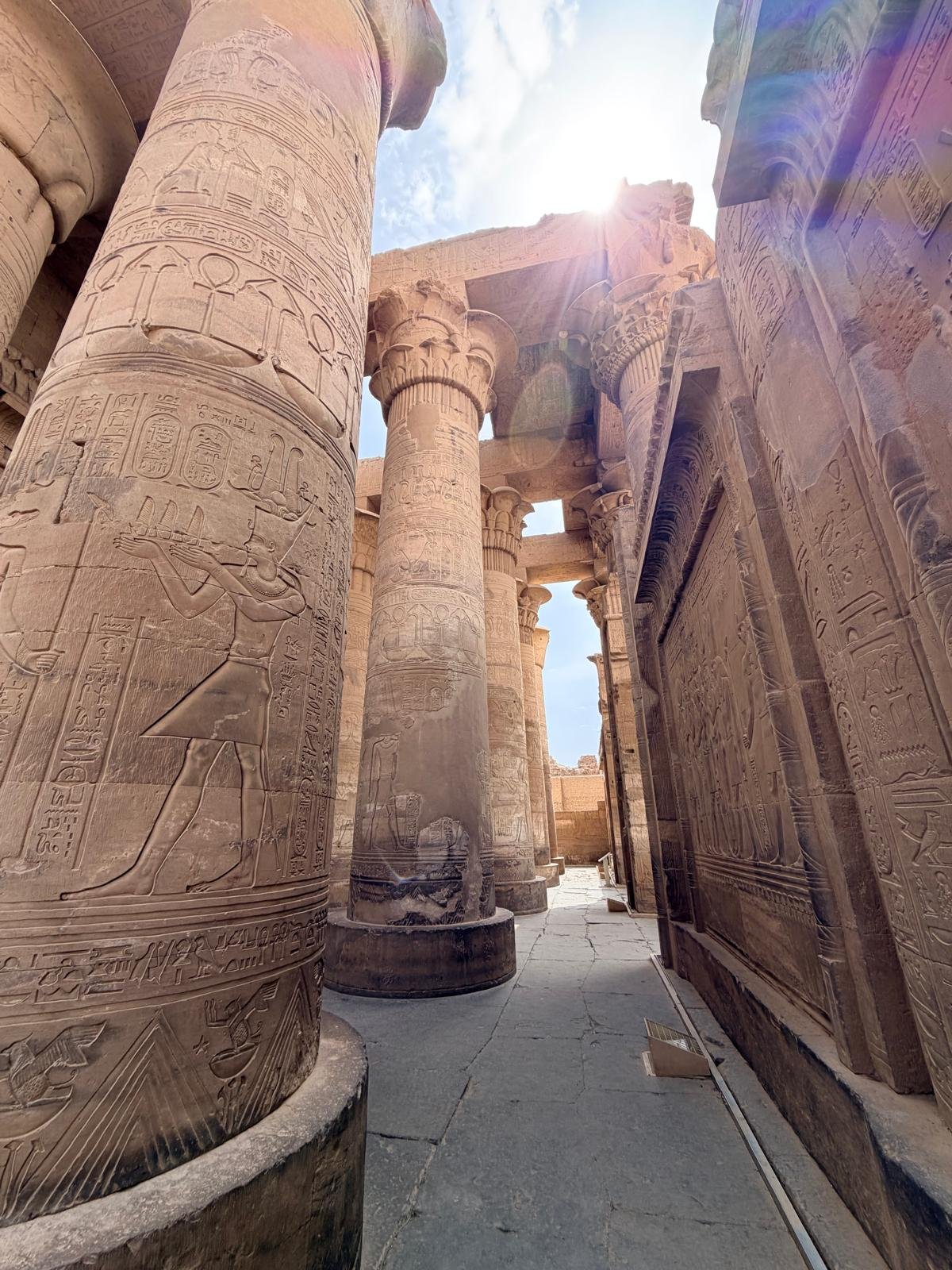
Standing before an obelisk etched with hieroglyphs—like the one captured in the temple ruins along our route—you feel the weight of continuity.
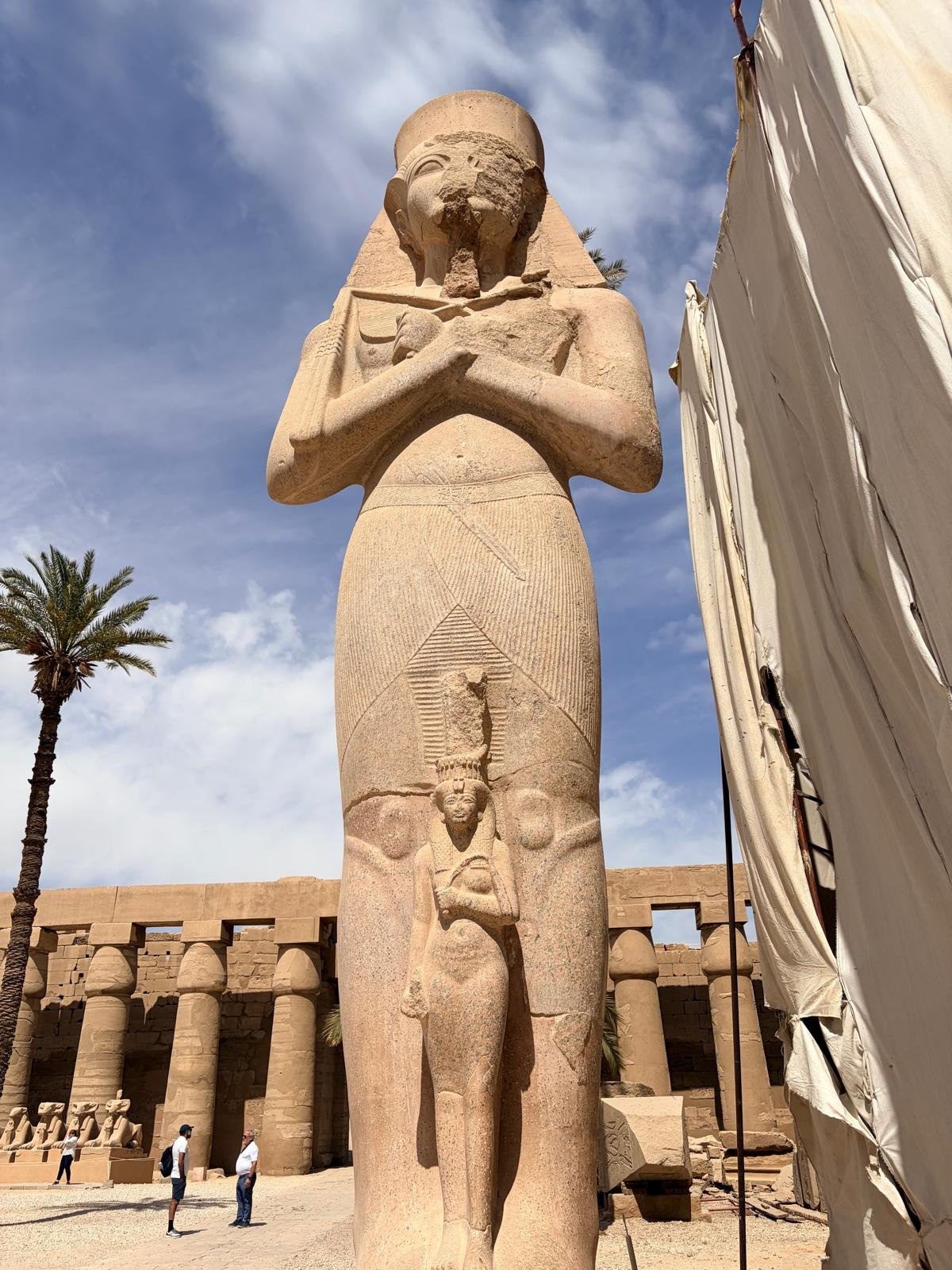
These stones speak of Ramesses II, the warrior king whose monuments stretch across the land, his image immortalized in colossal statues and inscriptions proclaiming divine authority.
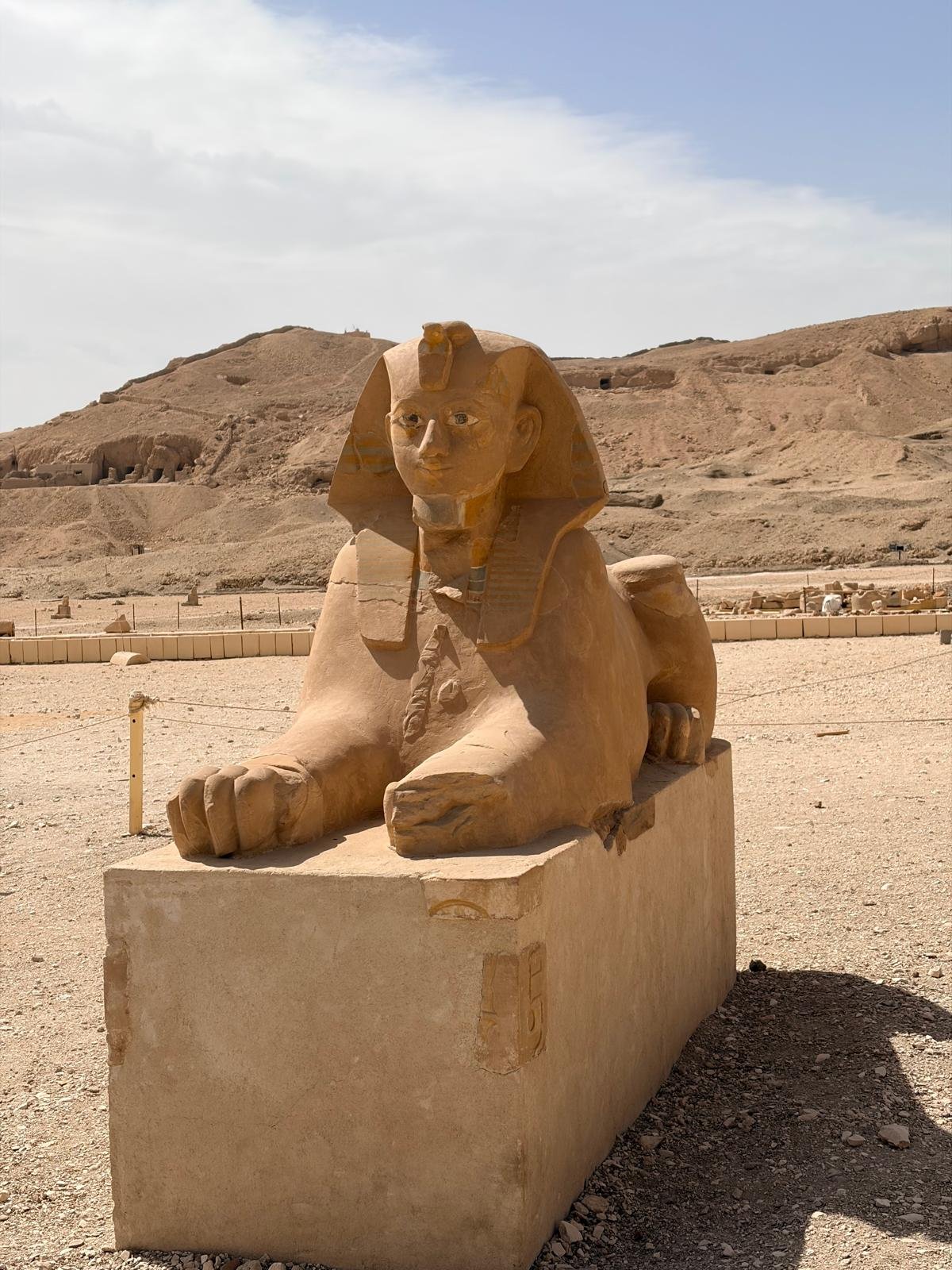
They whisper of Hatshepsut, one of history’s most remarkable rulers, who defied convention to govern as pharaoh and commissioned elegant temples that still stand in defiance of time.
They recall the campaigns of Thutmose III, often called the Napoleon of ancient Egypt, who expanded the empire’s reach deep into the Levant and Nubia.
And then there is Tutankhamun, the boy king whose relatively modest reign would have been forgotten were it not for the extraordinary discovery of his tomb in 1922. His story is a reminder that Egypt’s past is not static; it continues to reveal itself, layer by layer, to those who seek it.
But to truly understand Egypt, beyond the monuments, beyond the tourist gaze, one must also engage with the intellectual debates that have shaped how its history is interpreted.
Few figures loom as large in this regard as the Senegalese Historian and Anthropologist Cheikh Anta Diop. In the mid-20th century, Diop advanced a groundbreaking thesis: that ancient Egypt was fundamentally an African civilization, culturally and biologically linked to the rest of the continent. Through a multidisciplinary approach—combining linguistics, anthropology, history, and even melanin dosage tests—he challenged dominant Eurocentric narratives that had long sought to detach Egypt from Africa.
Diop’s work was not merely academic; it was political and philosophical, reclaiming a historical continuity that colonial scholarship had fragmented.
He argued that the Nile Valley civilization should be understood as part of a broader African civilizational matrix, influencing and interacting with regions far beyond its borders. His ideas sparked intense debate, but they also opened new pathways for rethinking Africa’s place in world history.
This intellectual legacy was further explored and contextualized by Cameroonian sociologist Jean-Marc Ela, who reflected on Diop’s work within the broader struggle for epistemological independence in Africa.
Ela emphasized that Diop’s contribution went beyond Egyptology—it was about restoring agency to African historical thought, challenging the structures of knowledge that had marginalized African voices.
For Ela, engaging with Diop was part of a larger project: re-centering Africa in its own narrative, and questioning the frameworks through which history itself is written.
Seen through this lens, the temples along the Nile take on an added dimension. They are not only relics of a distant past, but also sites of ongoing intellectual and cultural negotiation—symbols around which questions of identity, heritage, and power continue to revolve.
Yet Egypt is not only a relic of antiquity. It is profoundly African in its roots—its civilization born from the rhythms of the Nile, its people shaped by centuries of interaction across the continent.
At the same time, Egypt has always been a crossroads, absorbing influences from the Mediterranean, the Middle East, and beyond. Greeks, Romans, Byzantines, Arabs, Ottomans, and later European powers all left their mark.
For long stretches of its history, Egypt existed under foreign rule, its sovereignty shaped by successive empires until it emerged as an independent nation in the 20th century.
This layered identity—African, Arab, Mediterranean, and global—is palpable as you move through the country today. In the markets of Luxor, in the Nubian villages near Aswan, in the cosmopolitan energy of Cairo, Egypt reveals itself not as a singular narrative but as a mosaic.
Despite the turbulence that has affected parts of the Middle East in recent years, Egypt remains a major global tourism destination. There is a quiet resilience here—a sense that the country has weathered far greater upheavals across its long history.
Visitors continue to arrive, drawn by the promise of encountering something timeless. And indeed, standing before a temple wall illuminated by the fading light, or watching the Nile darken under a storm-heavy sky, you understand why.
As the sandstorm intensifies and the wind begins to whip across the deck, the outlines of the landscape soften into abstraction. The obelisks, the columns, the distant hills—all dissolve into a shifting haze. It is a fleeting moment, yet it feels symbolic.
Egypt has endured invasions, transformations, and centuries of change, yet it remains—anchored by the world longest river, sustained by memory, and constantly renewing itself.
By the time the storm passes, the sky will clear again. The Nile will return to its calm, eternal flow. And somewhere along its banks, another fragment of (African) history will emerge from the sand, waiting to be seen.
SHOP THE CHANGEMAKERS COLLECTION











The Nile at sunset has a way of slowing time.