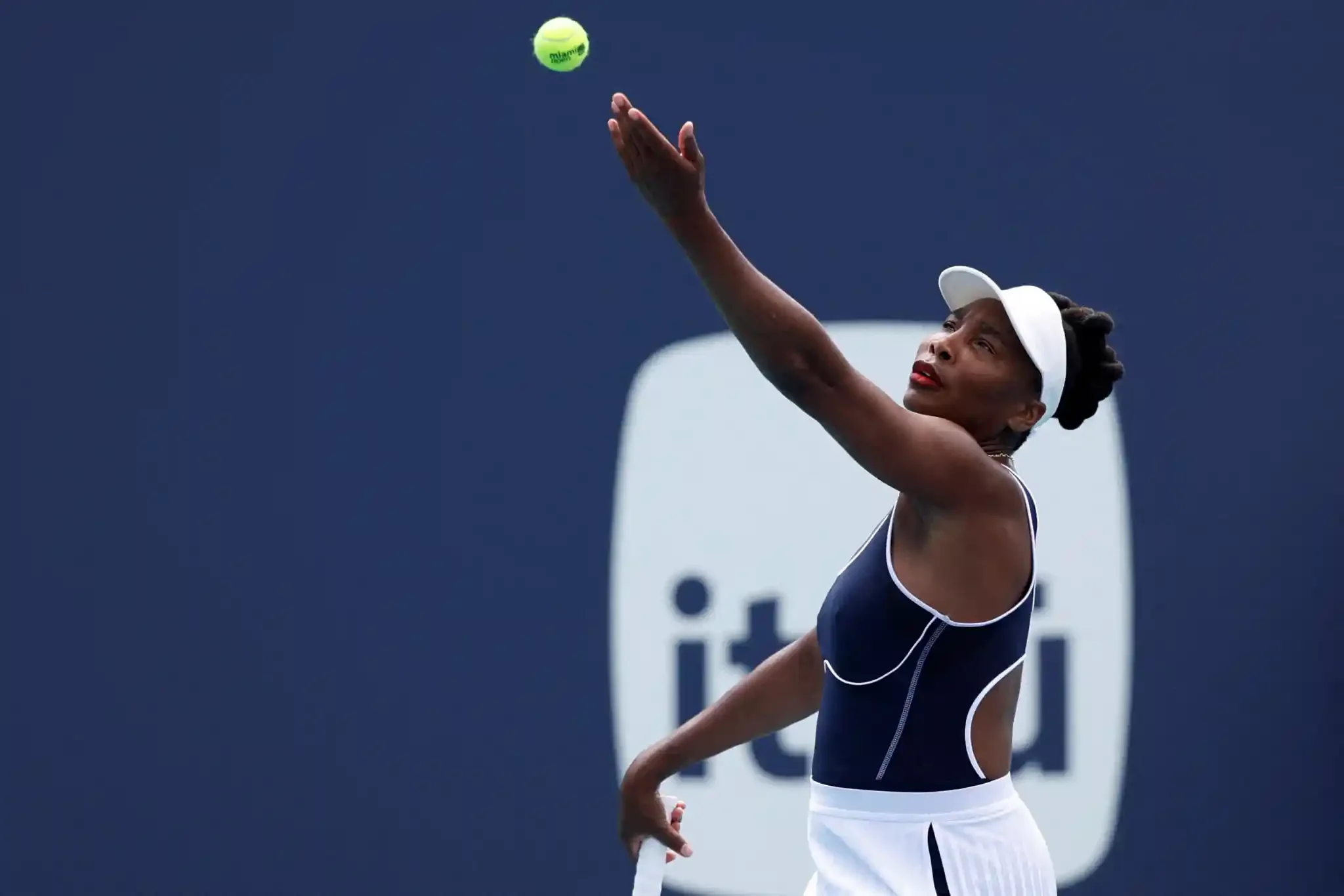
Venus Williams. Credit: Geoff Burke-USA TODAY Sports/File Photo
At 45 years old, Venus Williams walks onto the courts of Melbourne once again. Not chasing records, not chasing relevance, simply present in a tournament and a sport, accelerating away from everything that once defined it.
Granted a main-draw wild card, Venus becomes the oldest player ever to compete at the Australian Open. A seven-time Grand Slam champion and former world number one, her presence is not a challenge to the future, but a reminder of time itself and of careers shaped over decades, not weeks; and of a sport that once measured greatness through longevity as much as immediacy.
In a tournament dominated by youth, Venus does not slow the transition, she gives it depth.
The 2026 Australian Open is not merely the first Grand Slam of the season. It is a statement about where tennis stands today: between an openly embraced generational shift and the lingering symbolic power of those who shaped the game before acceleration became the norm.
In Melbourne, time feels compressed. The new generation has already taken over the world’s top 50. They are younger, more driven, and remarkably uniform in their intensity. The average age of the top 50 now stands at around 26, compared to nearly 29 a decade ago, a clear sign of how quickly renewal has taken hold.
The very top remains firmly locked. Just beneath it, competition is relentless, every ranking position contested with a ferocity that leaves little margin for stagnation.
Alcaraz – Sinner: the axis of the present
The defining thread of the men’s game runs through Carlos Alcaraz and Jannik Sinner.
Their rivalry began quietly on November 3, 2021, far from the spotlight, when both were still viewed as promising prospects rather than inevitable champions. Since then, it has grown into the central axis around which the men’s tour now revolves.
Their repeated clashes in semifinals and finals have restored an intensity reminiscent of tennis’s great rivalries. The 2025 Roland-Garros final is now widely regarded as one of the greatest matches of the modern era. Their 2022 US Open quarterfinal (lasting 5 hours and 15 minutes) remains the second-longest match in the tournament’s history.
The echoes of the Big 3 era (Roger Federer, Rafael Nadal, Novak Djokovic) are unmistakable. But the structure has changed. Today, the men’s tour is no longer defined by a trio, but by a Big 2.
For more than a year, Alcaraz and Sinner have shared the world number one ranking. The points gap between them and the third-ranked player now exceeds 2,500 points, a separation comparable to the distance between today’s world number three and a player ranked around 70th. The summit has pulled decisively away.
A less intimidating summit, a more dangerous base
Yet while the peak is clearly defined, the rest of the landscape is anything but stable.
The current top 10 feels less intimidating than it did two decades ago. Its players are more exposed mentally and far more accustomed to losing to lower-ranked opponents. Dominance, once assumed, now has to be constantly defended.
By contrast, the top 50 has never been this dense. Players ranked outside the top 30 are capable of producing exceptional runs in any given week. Valentin Vacherot illustrated this volatility vividly at the 2025 Shanghai Masters 1000, where, ranked outside the world’s top 200 at the time, he pulled off one of the shocks of the season by winning the tournament at 26 years old.
The base of the pyramid has grown sharper, more dangerous, less predictable.
The women’s draw and American momentum
On the women’s side, the contrast with the men’s game is striking.
Where the men’s circuit revolves around two central figures, the women’s draw remains genuinely open. World No. 1 Aryna Sabalenka arrives in Melbourne having already claimed two titles this season, reinforcing her status as the reference point of the tour.
Iga Świątek, now a six-time Grand Slam champion, remains one of the tournament’s most anticipated players capable of imposing her rhythm, but visibly more vulnerable when removed from the comfort of clay.
From an American perspective, momentum is tangible. Coco Gauff, crowned at the 2023 US Open, has firmly established herself among the elite. Madison Keys, now widely viewed as the most consistent player in the American contingent, made a defining statement by winning the 2025 Australian Open, the culmination of a career built on resilience and persistence.
Jessica Pegula continues to face the same unanswered question. Despite multiple Grand Slam semifinals and one major final, the mental hurdle separating her from a first Grand Slam title remains firmly in place.
Behind them, players such as Elina Svitolina, Paula Badosa and Elena Rybakina serve as constant reminders that, in the women’s game, the list of credible contenders remains long and refreshingly open.
Wawrinka, Venus, and the long view
Not everything in Melbourne moves at full speed.
Alongside Venus Williams, Stanislas Wawrinka represents another pause in a tour obsessed with immediacy. At 40, Wawrinka has announced that the 2026 season will be the final chapter of his career. A three-time Grand Slam champion (Australian Open 2014, Roland-Garros 2015, US Open 2016) his presence evokes an era when defeating the Big 3 was a rare and extraordinary achievement.
Wawrinka played three Grand Slam finals against Roger Federer and Novak Djokovic, and won all three. Today, he is no longer chasing outcomes, but inhabiting the moment.
Venus, meanwhile, continues to exist outside conventional timelines. She moves through the draw like a phoenix, rare and symbolic within a circuit in constant renewal. Her career resists reduction to numbers. It insists on duration.
These figures are not relics. They are context.
The season begins
The Australian Open is more than a tournament. It is the official beginning of a long season one shaped by acceleration, volatility, and relentless pressure.
A men’s game now driven by two young outliers. A women’s draw defined by depth and possibility. A tour that offers no breathing room, no guaranteed narratives.
The rest will unfold week after week, across surfaces and continents, through moments of brilliance and sudden collapse.
The season is underway.
Fast. Demanding. Unforgiving.
And still, occasionally, willing to remember how long greatness can last.
SHOP THE CHANGEMAKER COLLECTION






























Can AI truly help engineer the perfect athlete?