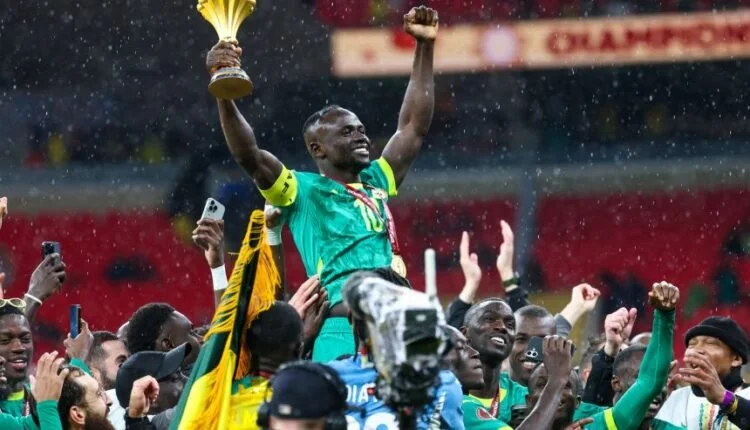
Senegal players celebrate winning the Africa Cup of Nations (AFCON). Photo: The Voice of Africa
January 2026, Rabat, Morocco. Europe and Africa felt closer than ever. The future co-host of the 2030 World Cup alongside Spain and Portugal, marking the first collaboration between two continents, Morocco was preparing to welcome Africa before welcoming the world.
The stage was set. Expectations were high. The symbolism was unmistakable.
High expectations on every front
The 35th edition of the Africa Cup of Nations was meant to be an AFCON of change. In just two years, revenues doubled. While the 2024 AFCON in Côte d’Ivoire generated €80 million in television rights, the 2026 edition brought in €150 million, driven by ever-growing visibility. The tournament was no longer merely a football competition reserved for Africa and its diaspora. It had become a structured economic product, capable of rivaling the world’s major international competitions in both visibility and revenue.
On the pitch, the stars showed up. Seasoned African Ballon d’Or winners shared the stage with the next generation. Youthful talent and established names together, suggested African football was at its peak.
Few great stories, little spectacle, plenty of controversy
Historically, great stories are the very soul of AFCON.
On February 12, 2012, at the Stade d’Angondjé in Libreville, Gabon, Zambia won its first AFCON title just a few kilometers from the site where, 19 years earlier, 18 Zambian players had died in a plane crash while traveling to Senegal for a World Cup qualifier. Days before the final, the Zambian squad had gone to pay tribute at the crash site. They were accompanied by federation president Kalusha Bwalya, the greatest player in Zambia’s history, who had escaped the tragedy because he was due to join the team from Europe.
Cameroon, Morocco, Côte d’Ivoire, Mali, Senegal, Algeria, Egypt, Nigeria – between them, these eight nations have won 23 of the 34 AFCON titles.
For this edition, there were no surprises. All the favorites reached the quarterfinals. There were mouth-watering clashes on paper, yet little spectacle on the field, with the exception of the Côte d’Ivoire versus Egypt match, a thrilling 3 to 2 victory for Egypt. For most fans, the tournament had so far left a lingering sense of unfulfillment.
The menu was familiar. Tight matches. Cautious, defensive teams. Stars largely kept quiet.
The host nation Morocco, led by Achraf Hakimi, Africa’s Player of the Year and a Champions League winner with PSG, had been dominant in every match and boasted the tournament’s best defense. Carried by the euphoric host country atmosphere, they logically reached the final. Waiting for them was Senegal, led by Sadio Mané, two-time African Player of the Year in 2019 and 2021.
Atlas Lions vs Teranga Lions
At the Prince Moulay Abdellah Stadium in Rabat, a technological jewel built for the occasion, the two best teams of the tournament faced off.
A close match followed, with both sides focused first on defending. A logical 0 to 0 scoreline. Extra time loomed.
And then, everything tipped.
In the dying seconds, as extra time seemed inevitable, a Moroccan corner swung into the box and changed everything. A brief tussle. Nothing spectacular, just enough to plant doubt. VAR intervened. The verdict fell. Penalty.
The Teranga Lions erupted. Players surrounded the referee and protested, to the point that they walked off the pitch and headed for the locker room.
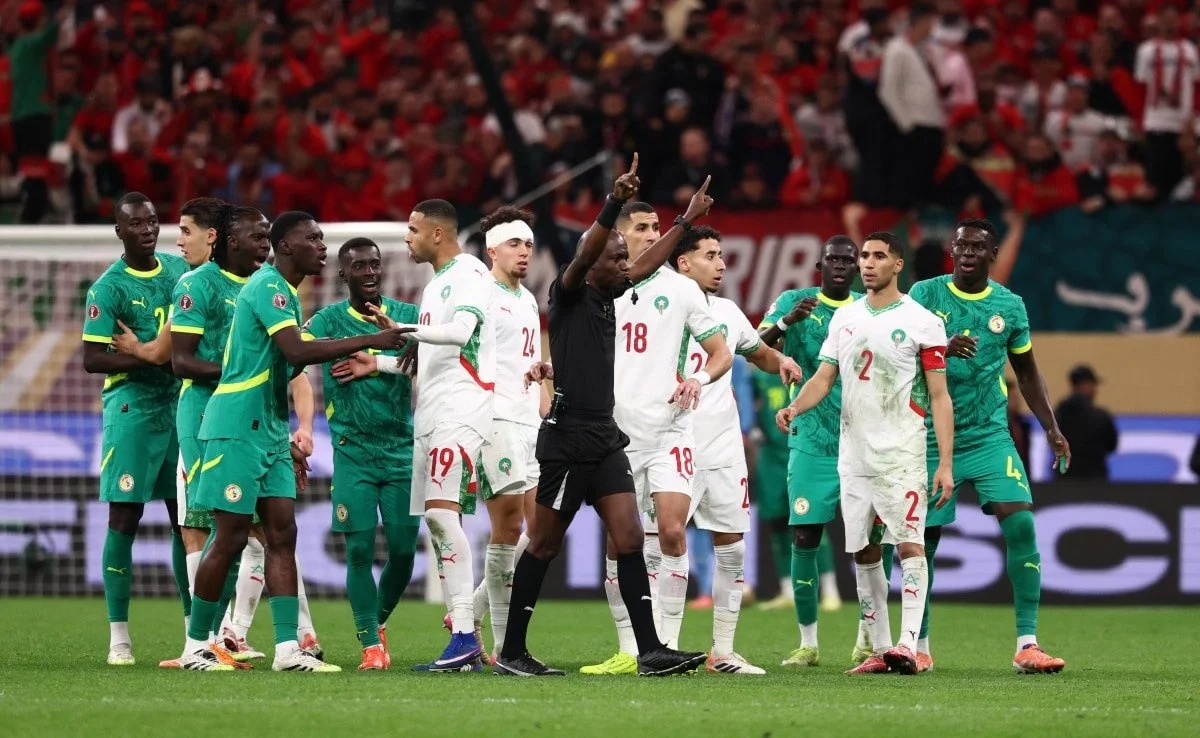
Confusion and frustration on the pitch. Photo: Forbes
Tension ignited in the stands. The atmosphere turned uncontrollable. CAF officials came down onto the pitch to calm the situation. The match was stopped.
Eventually, it was Sadio Mané who went to retrieve his teammates from the locker room, convincing them to return for extra time, unknowingly performing an act that would change the course of history.
The penalty was finally taken. Brahim Díaz stepped up. Panenka.
The goalkeeper had not moved.
The most important penalty of his life turned out to be the easiest to save.
Morocco thought they finally had their AFCON. Instead, the referee sent the game into extra time.
From the restart, in the 94th minute, Senegal surged forward. Pape Gueye sliced through the Moroccan defense and struck. Top corner.
Yacine Bounou, Morocco’s goalkeeper, voted best keeper of the tournament and previously impenetrable, was beaten. The Teranga Lions roared and claimed the second AFCON title in their history.
Less than ten minutes separated the missed penalty from Senegal’s winning goal. Ten minutes that entered football history.
First, Brahim Díaz, whose missed penalty recalls Roberto Baggio’s miss in the 1994 World Cup final. Years later, the Italian would tell The Athletic:
“If I had had a knife at that moment, I would have stabbed myself. If I had had a gun, I would have shot myself. At that moment, I wanted to die.”
Then came Sadio Mané’s decisive gesture, pulling his teammates back onto the pitch when Senegal faced severe disciplinary consequences, and potentially exclusion from future international competitions.
And finally, the liberating goal that changed everything. The symbol of a brutal emotional rollercoaster ride for players and spectators alike. Despair. Hope. Collapse. Explosion.
That is precisely why football is unique. Because in just a few minutes, it concentrates the most intense human emotions, even if, in the end, it remains just a game.
*In March 2026, Morocco were awarded the 2025 Africa Cup of Nations title after the Confederation of African Football ruled Senegal forfeited the final due to the walk-off. The decision is being appealed by the Senegalese Football Federation as of April 2026.
SHOP THE CHANGEMAKER COLLECTION

























Can AI truly help engineer the perfect athlete?