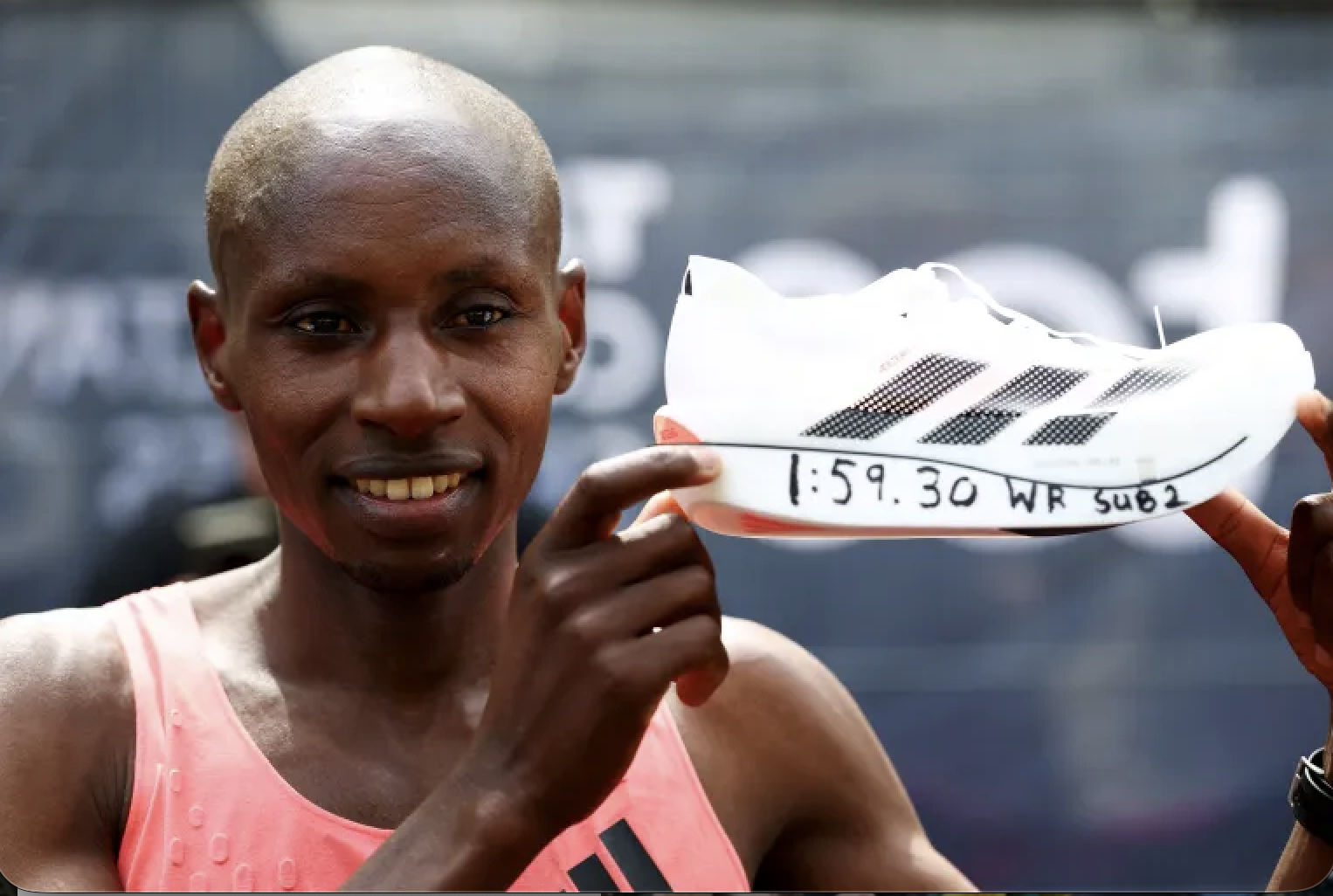
Kenyan runner Sabastian Sawe breaks the world record at the London Marathon [Photo: Matthew Childs/Reuters]
As Kenya’s Sabastian Sawe triumphantly crossed the finish line at the London Marathon after just 1:59:30, he became the first person to break the two-hour barrier in an official race. With a new world record to his name, and all of the accolades that come with achieving this prestigious feat, Sawe ensured that Kenya once again stamped its dominance in the running world.
Most of us amateur or would-be athletes can barely wrap our minds around Sawe’s ability to maintain an average pace of approximately 4:33 per mile over 26.2 miles, and still have enough left in the tank to accelerate to an insane 4:17 per mile pace in the final 2.2 kilometers of the marathon. While this level of athleticism can seem almost otherworldly, growing evidence suggests that technology, particularly artificial intelligence, is having an effect on performance outcomes across sports.
Technology as a tool for performance enhancement is not new in sports, with modern day athletes across basically all sports using a variety of methods to improve their endurance and even prevent injuries. In fact, AI has been at play as a performance enhancement tool for longer than one might expect. As early as the 1990s, AI-based technologies were used in sports to review game statistics and analyze player performance with insights on how to improve. In the 2000s, these technologies expanded rapidly with motion-tracking technology like Hawk-Eye being utilized in tennis, as well as Amisco and Prozone, who are considered pioneers in computerized tracking technology, being used in professional football (soccer).
As expected, access to AI-driven technology is closely tied to resources. Simply put, the more well-funded and supported an athlete is, the greater their access to advanced performance-enhancing tools; often widening the advantage rather than leveling the field. Despite this, pertinent questions remain. To what extent does “natural talent” still shape athletic performance today? Can AI truly help engineer the perfect athlete, or are there hard limits to what any individual can ultimately achieve? And at what point does biology, rather than technology, set the ceiling on human performance?
While many more studies need to be done before any of these questions can be definitively answered, there is clear evidence that AI-based technology is indeed having a positive effect on sports performance. A recent study on the associations of AI-assisted training on sport performance among student athletes showed that using AI tools in training ultimately improved performance. The study also found that AI had a behavioral impact on the student athletes, improving their decision-making and technique.
Back in Kenya, AI-driven technology is accelerating in use with start-ups emerging to assist Kenyan athletes in systematically tracking and analyzing data from training sessions and games, as a way to foster not only improved performance but also to develop smarter, more informed, training plans.
Ultimately, the jury is still out on whether AI can meaningfully close the gap between well-funded athletes and those who rely primarily on natural talent and limited resources. What is clearer, however, is that AI has the potential to gradually narrow the distance between what once seemed miraculous and what is now technically achievable. Despite this, access, infrastructure, and investment continue to shape who benefits most from these advancements. As the technology evolves, the question may not only be how far AI can push human performance, but also who gets to be part of that future in the first place.
SHOP THE CHANGEMAKER COLLECTION

































Can AI truly help engineer the perfect athlete?